



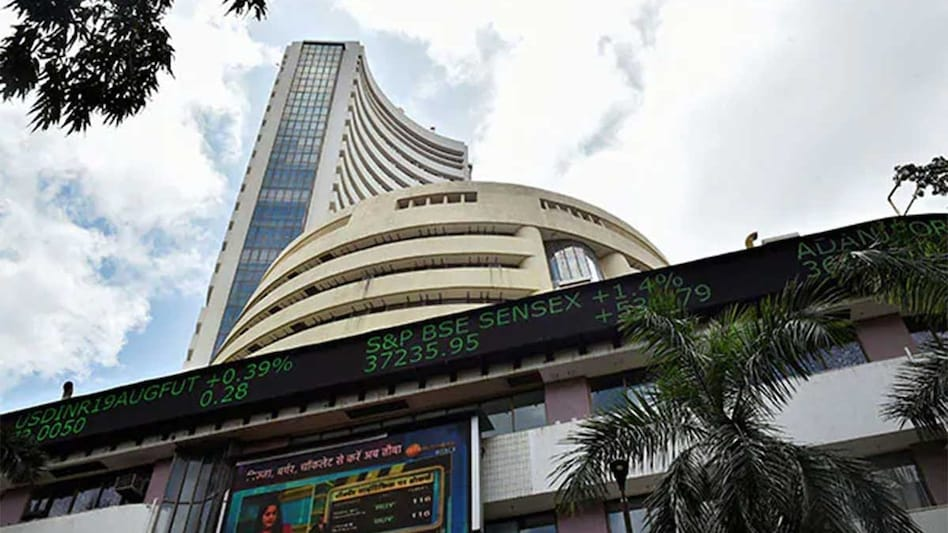
Share Market: According to HSBC, local investors and government initiatives will provide the stock market with a substantial amount of support. Next year, the Sensex might yield a 13% gain. The Sensex Index of the Bombay Stock Exchange may rise to 94,000 as a result of the increase in investment.
After staying flat this year, the Bombay Stock Exchange (BSE) Sensex may yield returns of up to 13% the next year. According to HSBC, the Sensex, which is currently trading at about 82,000, might rise to 94,000 by the end of 2026. It has also raised Indian stocks from neutral to overweight.
According to the Hongkong and Shanghai Banking Corporation (HSBC), favorable government policies, rising market valuations, and continuously rising domestic investor participation were the main causes of the change in attitude. This indicates a change in HSBC’s equities view with an emphasis on Asia, which solidifies India’s status as a reasonably appealing stock market in the midst of the unstable Asian area.
In comparison to the previous year, foreign investors have decreased their market share in India, according to HSBC. Nonetheless, the market has remained stable due to the continued presence of domestic investors. The Indian market has stayed steady in contrast to other Asian markets, especially those in Taiwan and South Korea, which see notable swings. Strong macroeconomic foundations and encouraging policies are responsible for this stability. The government’s dedication to reforms and growth fueled by capital expenditures, balanced income values, and a lack of foreign investment all contribute to the Indian market’s continued appeal.
The Asia-Pacific markets will increase by 20%.
Citing ongoing investor confidence and the speed of policy improvements, HSBC maintains its optimism despite a possible downturn in earnings. Due in great part to local retail investors, Asia Pacific equities markets have increased by 20% so far this year.
- With an overweight position in China and Hong Kong, HSBC anticipates that by 2026, the FTSE China index would provide 21% returns and the FTSE Hong Kong index will yield 16%.
Korea received a worse ranking. ASEAN markets are still slow.
Korea’s rating has been cut to underweight by HSBC. Due of political unpredictability, ASEAN markets continue to lag. Japan’s market valuations are still high even though the country is profiting from its weak currency.
- India’s market is still stable despite the unrest in other Asian countries, such as Taiwan and Korea, according to HSBC.
Profit booking in bank-auto stocks caused the Sensex to drop 386 points, while capital declined by Rs 3.02 lakh crore.
Profit booking in bank, car, and capital goods companies caused the domestic stock market to drop Wednesday for the fourth straight trading session. Investor sentiment was also impacted by the increase in the US H-1B visa fee and the capital flight of overseas institutional investors. The Sensex ended the day at 81,715.63, down 386.47 points. It had dropped to 494.26 points during trading. The Nifty dropped 112.60 points to settle at 25,056.90. Listed businesses’ capital dropped to Rs 460.56 lakh crore, a reduction of Rs 3.02 lakh crore.
- Twenty-one of the thirty Sensex companies saw their shares close lower, with Tata Motors suffering the worst loss at 2.67%.
- The stock of nine businesses, including NTPC and Powergrid, increased to 1.63 percent.
- The BSE Smallcap index experienced a 0.50 percent decline, while the Midcap index experienced a 0.85 percent decline. With a 2.47 percent decline, the Realty index suffered the most.
Read More: Navratri Fasts: Try These Energy-Boosting Sattvic Drinks

| Join Our Group For All Information And Update, Also Follow me For Latest Information | |
| Facebook Page | Click Here |
| Click Here | |
| Click Here | |